Look around you, the buildings you work in, the vehicles you drive, the bridges you cross, and the infrastructure that connects Indonesian cities. What do they all have in common? Welding. This fundamental joining process has quietly shaped modern civilization, yet few people know its fascinating journey from ancient forges to today’s automated production lines.
Understanding the history of welding invention reveals not just technological progress, but also how human ingenuity has continuously improved the way we build and create. Whether you work in construction, automotive manufacturing, or industrial production, appreciating this history gives you deeper insight into the processes that underpin modern industry.
The Ancient Origins of Metal Joining
Welding Before Modern Times
The story of welding invention begins much earlier than most people imagine, over 5,000 years ago in ancient Egypt, around 3000 BC. Long before electricity, before the Industrial Revolution, even before the great empires of Rome and Persia, ancient metalworkers discovered that metals could be joined together permanently.
These early craftsmen developed three primary techniques for joining metals, each representing a significant milestone in the evolution of welding technology:
Forge Welding
The oldest form of welding, forge welding involved heating metal pieces in a forge until they reached a semi-molten, plastic state. Blacksmiths would then hammer the pieces together, using pressure and heat to create a solid bond. This technique required exceptional skill to judge the correct temperature, too cold and the metals wouldn’t bond; too hot and they would burn or become brittle.
Riveted Joints
While not welding in the modern sense, riveting was a crucial joining technique. Metalworkers would drill holes through overlapping pieces, insert a metal pin (rivet), and hammer the end to create a mechanical bond. This method was used extensively in shipbuilding and would remain dominant until the 20th century.
Brazing
Perhaps the most sophisticated early technique, brazing used a lower-melting-point metal alloy as an adhesive to join higher-melting-point metals. This allowed craftsmen to join metals without melting the base material itself, a principle still used in modern manufacturing.
Archaeological Evidence of Early Welding
The history of welding invention isn’t just theoretical, we have physical evidence from archaeological discoveries. In ancient Mesopotamia (modern-day Iraq and Syria), researchers found a copper decorative plate featuring a stag’s head with antlers attached using brazing techniques. The precision and durability of this ancient joint demonstrates remarkable technical sophistication.
Even more impressive is the discovery of forge-welded iron ornaments in the golden coffin of Egyptian Pharaoh Tutankhamun, built around 1400 BC. These artifacts prove that metalworking and joining techniques were already advanced in ancient civilizations, supporting both artistic expression and practical applications.
The Industrial Revolution: A Turning Point
The Birth of Arc Welding
For thousands of years, welding techniques evolved slowly, passed down from master to apprentice. But the 19th century Industrial Revolution changed everything, accelerating the pace of welding invention dramatically.
1807: British scientist Sir Humphry Davy discovered the electric arc. Using a voltaic cell (an early battery), Davy created a brilliant light by passing current between two carbon electrodes. The phenomenon was named “arc” because the light curved like a bow (in Latin, “arcus”).
Initially, nobody saw welding applications, researchers focused on developing arc lamps for street lighting. It would take nearly 70 years before someone recognized the arc’s potential for joining metals.
From Laboratory to Workshop
Around 1880, French scientist Auguste de Méritens began using carbon arc heat to join lead plates in storage batteries. His apprentice, Nikolai Benardos, saw greater possibilities. Benardos made various improvements and developed a practical arc welding method, which he patented. This marked the true beginning of modern welding invention.
Almost simultaneously, inventors in the United States and the Soviet Union developed “metal arc welding”, using a metal electrode instead of carbon. This became the foundation for shielded metal arc welding (SMAW), commonly known as “stick welding,” which remains widely used today.
By the late 19th century, welding technology began rapidly spreading through industrial applications. Shipbuilding, railroad construction, and manufacturing all adopted these new techniques, recognizing their superior strength and efficiency compared to riveting.
20th Century: The Era of Diverse Welding Methods
The 20th century saw an explosion of welding invention, with engineers developing specialized methods for different applications and materials.
Resistance Welding (Early 1900s)
Resistance welding revolutionized mass production. The principle is elegant: squeeze two metal pieces between electrodes, pass electric current through them, and resistance heating at the contact point melts and fuses the metals together.
This invention led to spot welding and seam welding, perfect for automobile body panels, railway tracks, and pipe manufacturing. Today, resistance welding remains essential in automotive manufacturing, where speed and consistency are crucial. In Indonesia’s growing automotive sector, this technology enables efficient production of everything from car bodies to component assemblies.
Gas Welding (1900s-1910s)
At the beginning of the 20th century, France and Germany almost simultaneously developed industrial methods for producing oxygen through air liquefaction. This breakthrough made gas welding practical, as oxy-fuel welding requires substantial oxygen volumes.
Gas welding, particularly oxy-acetylene welding, quickly became popular in Europe and America for its portability and versatility. Gas welding remains valuable today for repair work, artistic metalworking, and situations where electricity isn’t available, particularly relevant in remote areas of archipelagic nations like Indonesia.
Semi-Automatic Welding (1920s-1930s)
As industrial production scaled up, manufacturers sought faster welding methods. American engineers developed semi-automatic welding between 1920 and 1930, replacing stick electrodes with continuous wire feed.
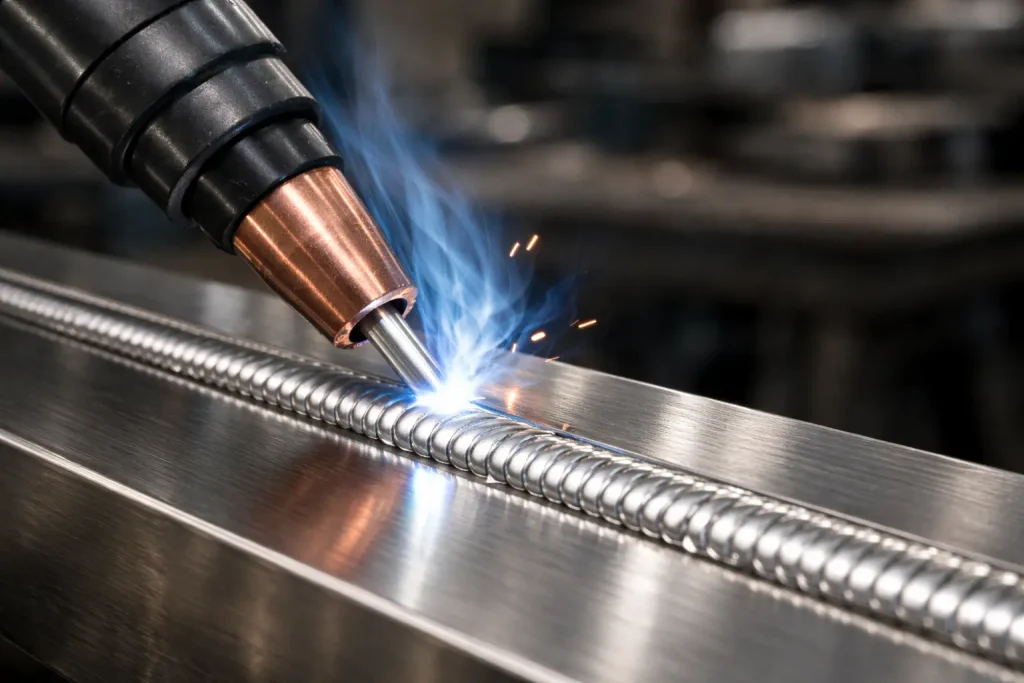
This welding invention dramatically increased productivity. Instead of stopping frequently to change electrodes, welders could work continuously, with wire automatically fed through the torch. Modern MIG and MAG welding evolved from these early semi-automatic systems, and today they’re among the most common methods in fabrication shops across Indonesia and worldwide.
Electron Beam Welding (1948)
Electron beam welding applies principles from vacuum tubes and cathode ray tubes to welding. Developed in 1948, this method focuses a stream of high-velocity electrons onto the workpiece, generating intense, concentrated heat.
The precision of electron beam welding made it ideal for aerospace, nuclear, and specialized applications requiring deep, narrow welds with minimal heat-affected zones. While less common in general manufacturing, it represents an important specialized capability for high-tech industries.
Laser Welding (1960)
The invention of the laser in 1960 opened new possibilities for welding. Laser welding focuses artificial light onto the workpiece, melting and fusing metals with extreme precision and minimal heat input.
This non-contact method can weld tiny components for electronics, create hermetic seals for medical devices, and join dissimilar metals that conventional welding can’t handle. Laser welding has become essential in automotive manufacturing, electronics production, medical device fabrication, and precision engineering, industries increasingly important to Indonesia’s economic development.
The Modern Era: Automation and Robotics
The Rise of Welding Robots
Today, we’re witnessing another revolution in welding technology, automation. Labor shortages driven by demographic changes, combined with demands for higher quality and productivity, have accelerated adoption of robotic welding systems.
Implications for Indonesian Industry
For Indonesia’s manufacturing sector, these technological advances present both opportunities and challenges. Automated welding systems offer:
Consistency
Robots produce identical welds repeatedly, ensuring quality control
Speed
Automated systems can operate continuously, increasing throughput
Safety
Robots handle hazardous tasks, protecting workers from fumes and UV radiation
Skill Preservation
Digitizing expert knowledge helps address skilled welder shortages
However, automation requires substantial investment in equipment, training, and infrastructure. Many Indonesian manufacturers are finding a balanced approach, using automation for high-volume, repetitive tasks while relying on skilled welders for complex, custom work.
Welding Wire: The Unsung Hero of Modern Welding
Throughout the history of welding invention, one element has remained consistently critical: the consumables. While we focus on machines and techniques, the quality of welding wire and electrodes directly determines weld quality, strength, and reliability.
Modern welding wire production involves sophisticated metallurgy, precise dimensional control, and rigorous quality standards. The wire must have:
✓ Consistent Diameter
Variations cause irregular wire feed and unstable arcs
✓ Proper Composition
Alloying elements must match the base material and application requirements
✓ Clean Surface
Contaminants cause porosity and weld defects
✓ Appropriate Tensile Properties
Wire must feed smoothly without breaking or bird-nesting
In Indonesia’s industrial landscape, sectors from automotive assembly in Jakarta to shipbuilding in Surabaya to infrastructure projects across the archipelago depend on reliable welding consumables. Whether producing car bodies, fabricating steel structures, or manufacturing machinery, consistent quality in welding wire translates directly to consistent quality in final products.
Manufacturers who understand this invest in certified, quality-controlled welding materials from reputable suppliers. The cost difference between premium and inferior welding wire is minimal compared to the expense of weld failures, rework, or structural problems.
Lessons from Welding History for Modern Industry
What can Indonesian manufacturers and fabricators learn from the history of welding invention?
Innovation Is Continuous
From ancient forge welding to modern laser systems, welding technology has never stopped evolving. Companies that stay informed about new techniques and equipment maintain competitive advantages.
Fundamentals Matter
Despite technological advances, basic principles remain: clean materials, proper heat input, adequate shielding, and skilled application. Master these fundamentals before pursuing advanced methods.
Quality Compounds Over Time
Archaeological artifacts demonstrate that quality welding lasts millennia. In your business, quality welds mean durable products, satisfied customers, and reduced warranty claims.
Specialization Has Value
Different welding methods emerged for different applications. Success comes from matching the right process, materials, and parameters to each specific job, not trying to use one method for everything.
Skills and Materials Both Matter
The best welder can’t overcome inferior materials, and the best materials won’t compensate for poor technique. Excellence requires both quality consumables and skilled application.
Welding in Indonesia’s Industrial Future
As Indonesia continues its economic development, welding will play an increasingly vital role. Infrastructure projects, automotive manufacturing expansion, shipbuilding, mining equipment fabrication, and construction all depend on high-quality welding.
The country’s position as an emerging manufacturing hub creates opportunities for companies that can deliver consistent quality. Meeting international standards, whether for automotive parts export, structural steel certification, or pressure vessel fabrication, requires not just skilled welders but also quality materials and robust quality control systems.
Indonesian manufacturers competing in global supply chains must understand that welding quality reflects on the entire nation’s industrial capability. Every properly executed weld, every certified product, and every satisfied customer builds Indonesia’s reputation as a reliable manufacturing partner.
Conclusion: Building on a Foundation of Innovation
The history of welding invention spans more than 5,000 years, from ancient Egyptian forge welding to today’s automated robotic systems. This journey reflects humanity’s endless drive to improve, innovate, and build better solutions.
For professionals in Indonesia’s manufacturing, construction, and fabrication industries, this history offers valuable perspective. You’re not just joining metal, you’re participating in a craft refined across centuries and cultures. The techniques you use today represent the accumulated knowledge of countless innovators who solved problems, improved processes, and pushed boundaries.
Whether you’re welding steel structures for Jakarta’s expanding skyline, fabricating automotive components for export, or producing machinery for mining operations, you’re part of this continuing story. By understanding where welding came from, you’re better equipped to appreciate where it’s going, and to contribute to the next chapter of welding invention.
Quality materials support quality work. Advanced techniques require proper tools. Success in modern welding demands both respect for fundamental principles and openness to innovation.
As Indonesia’s industrial sector grows, those who master this balance, combining traditional craftsmanship with modern technology, skilled technique with quality materials, will lead the way forward.