You know what’s funny? We’ve had welders walk into procurement meetings, throw around “TIG welding” like it’s second nature, only to get blank stares from the quality engineer who keeps pointing at the spec sheet that says “GTAW.” Meanwhile, everyone’s talking about the exact same thing.
It’s like calling it a lift versus an elevator. Same ride, different name. But here’s where it gets interesting: in the welding world, that naming difference actually matters when you’re writing procedures, quoting jobs, or trying to pass an inspection.
So let’s clear this up once and for all.
What Actually Is TIG Welding?
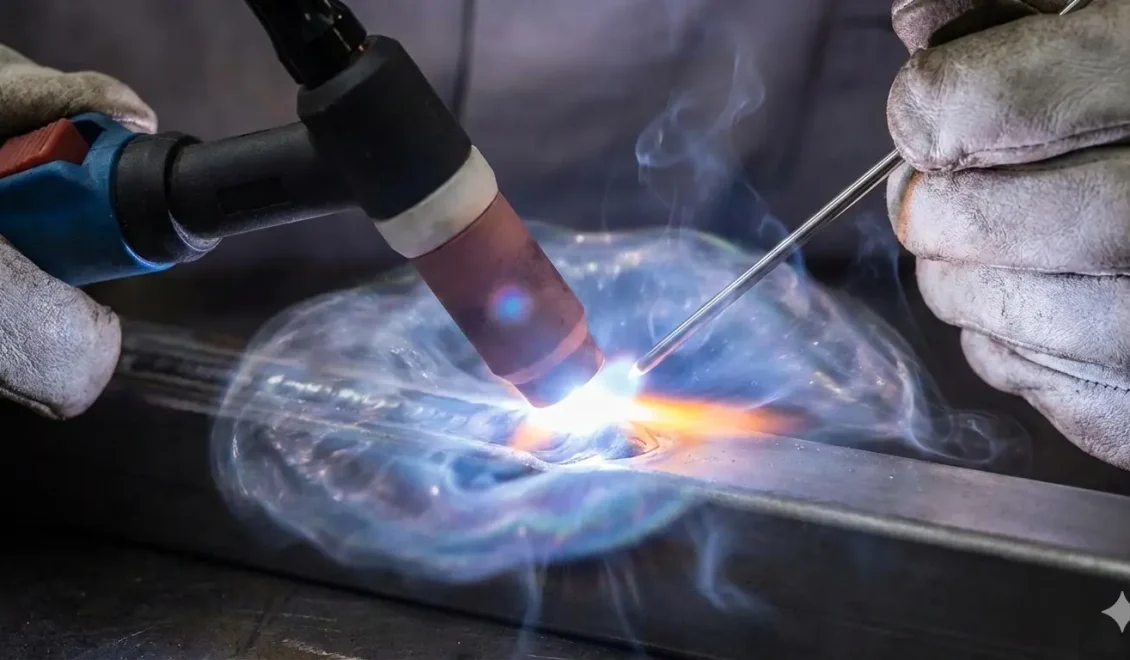
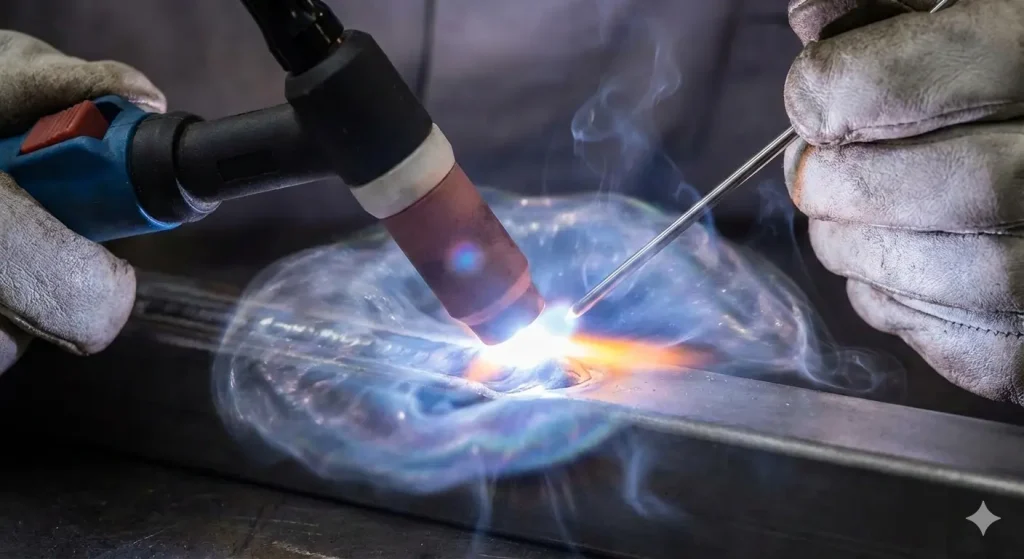
TIG stands for Tungsten Inert Gas welding. Picture this: you’ve got a torch in one hand, a tungsten electrode that doesn’t melt away (non-consumable, in fancy terms), and you’re feeding filler wire with the other hand while a blanket of inert gas protects everything from contamination.
The tungsten tip creates an electric arc that melts the base metal. You dip your filler wire into that molten pool, and boom, you’re building a weld bead. Clean, precise, and beautiful when done right.
The “inert gas” part? That’s usually argon flowing through your torch, keeping oxygen and nitrogen away from the weld puddle. Because when those atmospheric troublemakers crash the party, you get porosity, oxidation, and welds that’ll fail faster than a cheap umbrella in a typhoon.
Now Enter GTAW: The Same Process, Different Wardrobe
GTAW means Gas Tungsten Arc Welding. It’s the formal name that shows up in welding codes, procedure specifications, and any document that needs to pass through engineers, inspectors, and certification bodies.
Same tungsten electrode. Same arc. Same technique. GTAW is just TIG wearing a suit and tie instead of workshop coveralls.
The American Welding Society (AWS), International Organization for Standardization (ISO), and basically every standards body on the planet uses GTAW. Why? Because it’s more technically accurate and leaves less room for misinterpretation when you’re dealing with international suppliers or multi-million dollar projects where precision matters.
Here’s Where the Plot Thickens
Remember how TIG stands for Tungsten Inert Gas? Well, that’s where things get a bit messy.
Not all shielding gases used in this process are purely inert. Sometimes we add hydrogen to the argon mix, especially when welding stainless steel or certain alloys. Hydrogen isn’t inert, it’s reactive. So technically, calling it “TIG” becomes inaccurate the moment you dial in that hydrogen percentage.
GTAW sidesteps this problem entirely. “Gas Tungsten Arc Welding” doesn’t make any promises about the gas being inert. It’s just gas. Could be pure argon, could be argon-hydrogen, could be helium. The name still fits.
Key Insight: This is why procurement managers and welding engineers prefer GTAW in documentation. It’s future-proof. You can specify GTAW on a procedure, and whether your fabricator uses pure argon or a mixed shielding gas, the term still applies correctly.
The Real-World Impact: Why This Isn’t Just Semantics
Let’s say you’re sourcing welding wire for a major infrastructure project. Your RFQ (request for quotation) says “TIG welding wire needed.” Sounds clear enough, right?
Wrong.
A supplier in Jakarta might interpret that differently than one in Surabaya, especially if they’re working from translated documents or dealing with international standards. But if you write “GTAW welding wire per AWS A5.18 specification,” suddenly everyone’s on the same page. The standards reference removes ambiguity.
Intiroda’s Experience
We see this constantly at Intiroda. When clients come to us looking for welding wire, the ones who specify GTAW in their technical requirements get faster, more accurate quotes. Why? Because we know exactly which standards apply, what mechanical properties they need, and which product line matches their application.
Our ER70S-6 welding wire, for instance, is designed specifically for GTAW applications on carbon steel. When a fabricator’s procedure calls out GTAW with specific wire classifications, there’s zero confusion about what they need.
When to Use Which Term
Here’s your cheat sheet:
Use “TIG” when:
- Talking shop with other welders
- Training new operators on the floor
- Having casual conversations about welding techniques
- Marketing to consumers or small fabrication shops
- Discussing the process in everyday language
Use “GTAW” when:
- Writing welding procedure specifications (WPS)
- Creating requests for quotation
- Preparing inspection documentation
- Referencing code requirements (ASME, API, AWS, etc.)
- Communicating with international suppliers
- Certifying welders or documenting qualifications
Think of it this way: TIG is what you call it. GTAW is what you write.
How TIG/GTAW Fits Into the Bigger Welding Family
While we’re here, let’s connect the dots with other welding processes because the naming convention follows a similar pattern:
| Casual Name |
Formal Name |
| Stick welding |
SMAW (Shielded Metal Arc Welding) |
| MIG welding |
GMAW (Gas Metal Arc Welding) |
| TIG welding |
GTAW (Gas Tungsten Arc Welding) |
Notice the pattern? The casual names describe what you see or use (stick, metal inert gas, tungsten inert gas). The formal names describe the actual process mechanics (shielded metal arc, gas metal arc, gas tungsten arc).
Standards bodies love consistency. GTAW fits into this organized naming system where every arc welding process gets properly categorized and defined.
The Technical Deep Dive: Gas Matters More Than You Think
Let’s get specific about those shielding gases because this is where GTAW really proves its worth as terminology.
Pure argon works great for aluminum and magnesium. Add helium, and you get hotter, faster welds. Mix in hydrogen with argon (usually 5-15%), and you’ll see better penetration on stainless steel and duplex alloys, but only if your base metal can handle it.
Some materials hate hydrogen. It causes cracking in certain steels. But other applications benefit from it tremendously.
The point? GTAW as a term accommodates all these variations without needing an asterisk or footnote. TIG, with its “inert” label, technically doesn’t.
What This Means for Your Procurement Strategy
If you’re sourcing welding consumables, whether that’s tungsten electrodes, filler wire, or shielding gas, using GTAW terminology in your specifications does two things:
First, it signals that you understand welding codes and standards. Suppliers take you more seriously.
Second, it reduces the back-and-forth clarification emails. When Intiroda receives a quote request for “GTAW welding wire, ER70S-6, AWS A5.18,” we know immediately what product to quote, what certifications you’ll need, and what documentation to prepare. That’s faster turnaround for you.
Compare that to a vague “TIG wire” request where we have to ask: What base metal? What thickness? What mechanical properties? Indoor or outdoor application? Do you need mill test certificates?
The Bottom Line
TIG and GTAW are absolutely, positively the same welding process. You’re using a tungsten electrode, creating an arc, and protecting that weld with shielding gas. The technique doesn’t change. The equipment doesn’t change. The results don’t change.
What changes is the context. Shop floor? Call it TIG. Technical documentation? Write GTAW.
And here’s the thing nobody tells you: using the right terminology at the right time makes you look more professional. It shows you understand the industry standards, you’re serious about quality, and you’re not going to be the person who causes a spec revision three weeks into a project because of unclear terminology.
So next time you’re writing a welding procedure or putting together an RFQ, do yourself a favor: use GTAW. Your procurement department will thank you. Your suppliers will thank you. And your welds? They’ll turn out exactly the same, because at the end of the day, you’re still doing Tungsten Inert Gas welding, even if we’re calling it Gas Tungsten Arc Welding in the paperwork.
Frequently Asked Questions
Why do standards call TIG ‘GTAW’ instead?
Standards organizations prefer GTAW because it’s more technically accurate and doesn’t make assumptions about the shielding gas being purely inert. Since some GTAW applications use argon-hydrogen or argon-helium mixes (which aren’t strictly inert), the term “Gas Tungsten Arc Welding” covers all variations without being technically incorrect. It’s about precision in documentation.
Does GTAW always require a gas cylinder?
Yes, GTAW fundamentally requires shielding gas delivered through the welding torch to protect the weld pool from atmospheric contamination. The gas typically comes from cylinders, though larger operations might use bulk gas systems. Without that gas shield, you’re not doing GTAW, you’d be doing something closer to unshielded arc welding, which produces poor quality welds.
When is it wrong to call GTAW ‘TIG’?
It’s not “wrong” per se, but it’s inappropriate in formal documentation like welding procedure specifications, codes, inspection reports, or international procurement documents. Using TIG in these contexts can create confusion or suggest unfamiliarity with industry standards. However, calling it TIG on the shop floor or in training is perfectly fine and actually more common.
How do TIG, MIG, and stick names map to SMAW, GMAW, GTAW?
The casual names describe what you see: Stick (the electrode looks like a stick), MIG (Metal Inert Gas), TIG (Tungsten Inert Gas). The formal names describe the process: SMAW (Shielded Metal Arc Welding), GMAW (Gas Metal Arc Welding), GTAW (Gas Tungsten Arc Welding). Both sets refer to the same processes, just used in different contexts, casual versus formal documentation.